Start by identifying the kind of tiredness
“Tired” can mean poor sleep, training fatigue, soreness, stress, travel, low motivation, illness, or unexplained exhaustion. Those are different problems.
Ask what changed, how long it has lasted, what you did recently, and whether any symptoms make exercise inappropriate.
| Current pattern | Questions to ask | Likely direction |
|---|---|---|
| One poor night of sleep | Otherwise normal? Does easy movement help? | Move, Build, or Recover |
| Several poor nights | Are energy or performance declining? | Recover or Restore |
| Heavy legs after training | Normal soreness or unusual pain? | Usually Recover; stop for concerning pain |
| Mentally drained, physically normal | Would brief easy movement help? | Move or controlled Build |
| Illness or concerning symptoms | Fever, unusual weakness, dizziness, breathlessness, fainting, or significant pain? | Stop and seek appropriate guidance |
| Persistent unexplained fatigue | Persistent despite rest and reduced training? | Pause and seek evaluation |
One bad night is different from accumulated fatigue
One bad night does not always require full rest. If you otherwise feel normal and improve during an easy start, a shorter session may fit.
Several poor nights plus hard sessions, heavy legs, or declining performance suggest stress is stacking. Forcing the plan may add load without adding useful training.
Look at sleep, soreness, stress, recent training, and your response together, not as one score.
Normal soreness is not the same as a warning sign
Normal post-workout soreness is usually predictable and may ease with gentle movement. Sharp, worsening, localized, or unusual pain deserves more caution.
Stop and seek appropriate care for chest discomfort, fainting, unusual breathlessness, significant or worsening pain, acute illness, severe weakness, or other concerning symptoms. RiseMove cannot determine medical safety.
For ordinary fatigue, compare an easy walk, a reduced workout, Recover, or Restore.
Use an easy start as feedback, not as a diagnostic test
When exercise is otherwise appropriate, five to ten easy minutes can show whether you settle into movement or feel worse. It is feedback, not a medical test.
- Start below planned intensity. Keep it conversational.
- Notice the direction: better, unchanged, or worse?
- Reduce before increasing. A shorter session may be enough.
- Stop for worsening symptoms, unusual weakness, or increasing pain.
How tiredness maps to the five Daily Signals
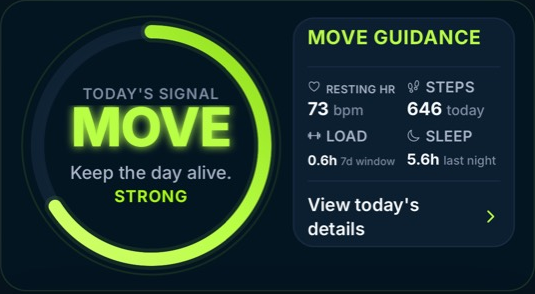
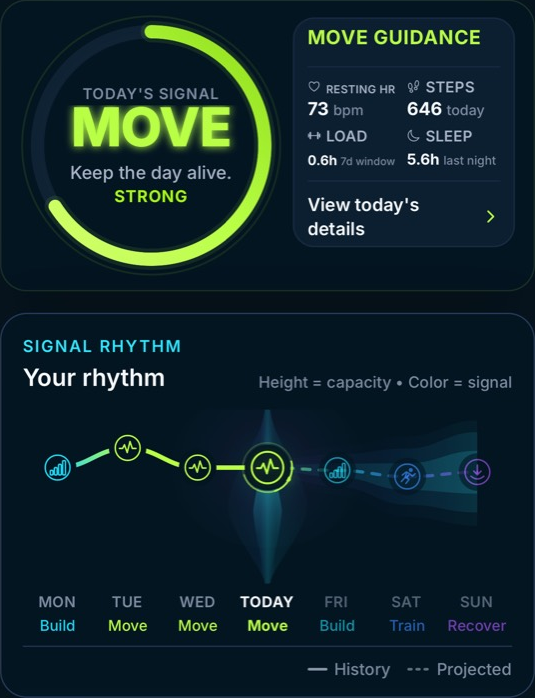
RiseMove separates the choice into five levels of intent instead of “work out” or “skip.”
| Signal | What it means on a tired day | Example |
|---|---|---|
| Move | Keep momentum with little added stress. | Short walk, easy mobility, or casual movement |
| Build | Controlled progress fits without maximum effort. | Brisk walk, steady ride, or lighter gym session |
| Train | The broader pattern supports higher effort. | Planned session after adequate recovery |
| Recover | Move easily without creating another hard day. | Easy spin, swim, walk, or mobility |
| Restore | Reduce demand and unload. | Rest, sleep, breathing, or gentle mobility |
| Safety override | Concerning symptoms override every Signal. | Stop; do not choose a workout level |
What RiseMove considers and what it cannot know
Available movement context
- Today’s check-in
- Energy, soreness, sleep, and stress
- Recent RiseMove activity
- Supported connected workout context
- Recent movement and plan context
Medical or safety determination
- Diagnose illness, injury, or overtraining
- Guarantee that a workout is safe
- Treat one wearable metric as the whole picture
- Override symptoms, restrictions, or professional advice
- Replace a qualified healthcare professional
Sources and reference notes
These sources support the general health and training guidance. RiseMove product details reflect the published app.
Frequently asked questions
Is it okay to exercise after one bad night of sleep?
Sometimes. One poor night differs from repeated sleep loss or training fatigue. Start easier and stop if you feel worse.
Is walking useful when I am tired?
Yes, when mild fatigue improves with easy movement. Do not use it to ignore exhaustion, unusual pain, or illness.
Should I rest if my legs feel heavy?
Heavy legs are one clue. Recent load, sleep, soreness, and your response to easy movement help separate Recover from Restore.
Can RiseMove tell whether I am sick or injured?
No. RiseMove does not diagnose illness, injury, or medical conditions and cannot determine whether exercise is medically safe.