
Readiness is a decision, not a trophy
A high-readiness day is not better than a recovery day. Readiness simply matches training stress to the body and life context you have today.
Ask “What level of movement is productive today?” The answer may be hard training, controlled work, easy movement, recovery, or rest.
Seven signals to consider before training
| Signal | What to notice | Why it matters |
|---|---|---|
| Sleep | One bad night or several? Alert and coordinated? | Repeated poor sleep can affect recovery and effort. |
| Soreness and pain | Normal soreness or sharp, worsening, movement-changing pain? | Normal soreness and warning pain need different responses. |
| Recent load | Are demanding sessions stacking? Was the last one harder than planned? | Readiness reflects the recent pattern, not one morning. |
| Energy | Flat, normal, or unusually strong? | Read energy with sleep, load, and symptoms. |
| Stress | Work, travel, heat, caregiving, or emotional strain? | Training is only one source of stress. |
| Motivation | Low motivation or a deeper physical issue? | Low motivation alone does not prove low readiness. |
| Easy-movement response | Do five to ten easy minutes help or make you worse? | An easy start can provide useful feedback. |
Translate readiness into a useful level of intent
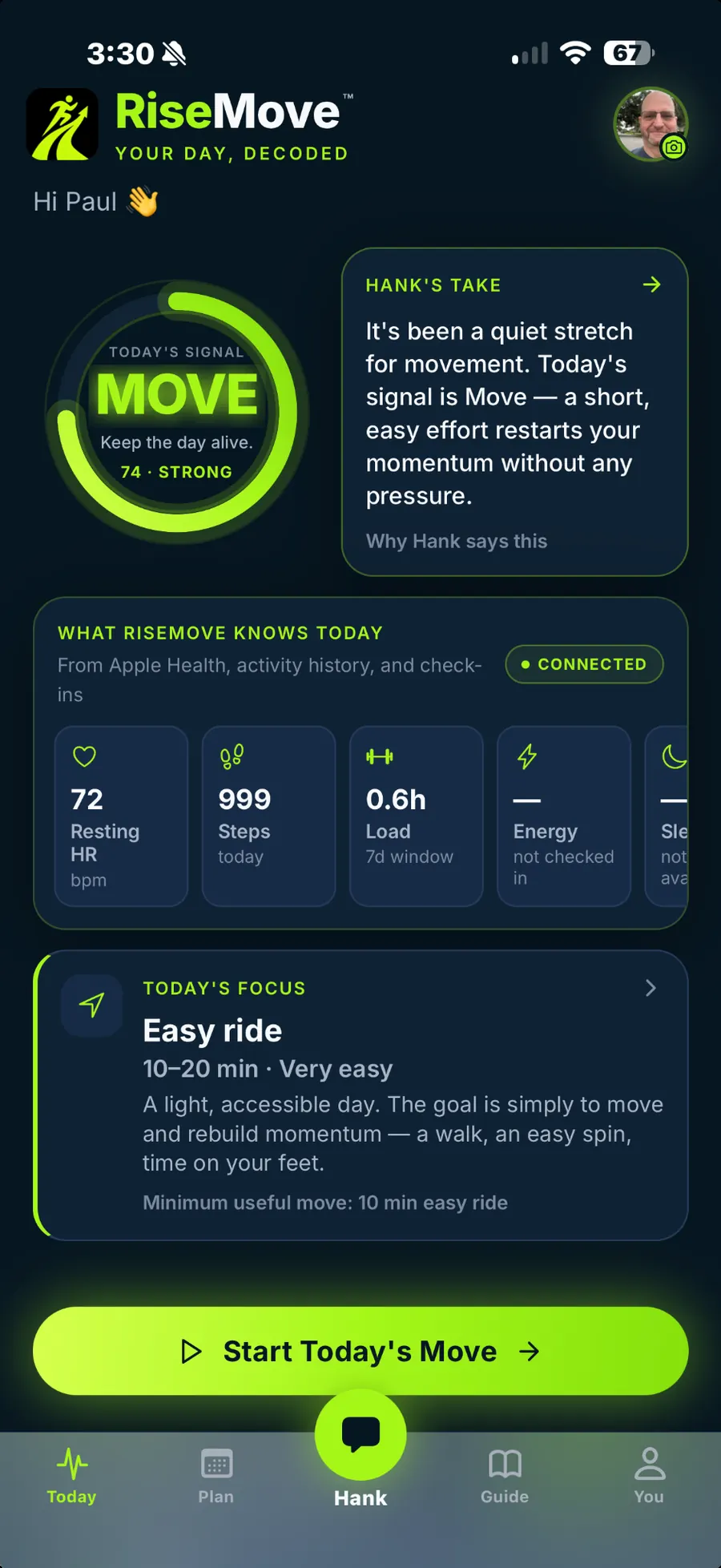
RiseMove expresses the decision as five Daily Signals. They are intents, not rankings.
| Signal | When it may fit | Examples |
|---|---|---|
| Train | Recovery, load, symptoms, and the plan support hard work. | Intervals, hard ride, demanding strength, or focused sport work. |
| Build | Controlled work fits without maximum demand. | Steady ride, brisk walk, moderate run, or lighter strength. |
| Move | Priority: momentum with accessible movement. | Short walk, mobility, easy swim, or light movement. |
| Recover | Easy movement may support adaptation without more load. | Easy spin, walk, mobility, or technique work. |
| Restore | The pattern calls for more unloading and less demand. | Rest, breathing, gentle mobility, or a low-load day. |
Use the warm-up as feedback, not permission to ignore symptoms
When exercise is otherwise appropriate, begin easy. Five to ten minutes can show whether your body is settling into the session.
- Start easy. You are gathering information, not proving anything.
- Notice direction: looser and clearer, or flatter and worse?
- Reduce before increasing. Shorter or easier may be enough.
- Stop when the response is wrong. The plan is not an obligation.
Stop and seek appropriate care for chest discomfort, fainting, dizziness, unusual breathlessness, worsening pain, acute illness, or other concerning symptoms. RiseMove cannot determine medical safety.
What RiseMove can consider and what it cannot know
Available context may include
- Today’s energy, sleep, soreness, stress, and check-in.
- Recent activity recorded in RiseMove.
- Approved Apple Health or Strava activity when connected.
- Current Signal, recent movement, goals, and plan context.
RiseMove does not
- Diagnose injury, illness, overtraining, or sleep disorders.
- Guarantee safety or performance.
- Treat one wearable metric as the complete answer.
- Override symptoms, restrictions, or professional advice.
For a deeper description of the product logic, see how RiseMove determines your Daily Signal.
Sources and reference notes
These sources support the general health and activity context. The five-Signal framework is specific to RiseMove.
Frequently asked questions
What is workout readiness?
Workout readiness is the practical question of how much training stress fits your recovery, recent activity, sleep, soreness, energy, and stress.
Is a readiness score always accurate?
No single score captures everything. Compare any score or Signal with symptoms, recent training, and how you feel.
Should I train hard whenever I feel good?
Not necessarily. A strong morning can coexist with accumulated load. The larger pattern still matters.
What if I feel worse during the warm-up?
Stop or downshift for worsening pain, unusual weakness, dizziness, chest discomfort, or abnormal shortness of breath.