
Different primary jobs, not an either-or choice
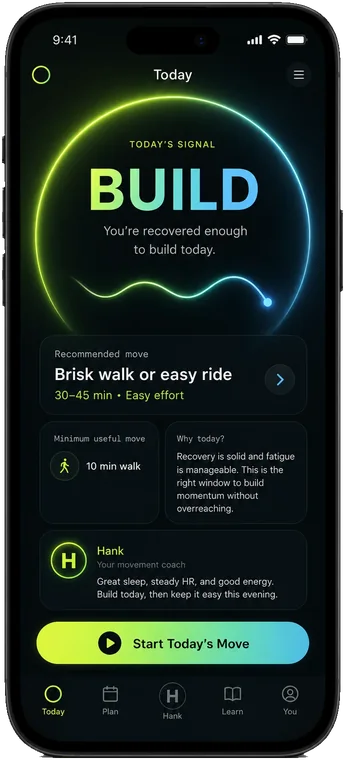
The products overlap in activity context but have different jobs. Strava centers on recording, analysis, exploration, and community. RiseMove turns recent movement and today’s check-in into a next-movement decision.
Strava is more than a basic tracker, with routes, segments, goals, analysis, training features, clubs, challenges, and social activity. RiseMove does not need to minimize those strengths to explain its role.
Keep the tools you use to track. Use RiseMove when the question is what fits today.
RiseMove vs. Strava at a glance
| Question | RiseMove | Strava |
|---|---|---|
| Primary product job | Decide what movement fits today. | Record, analyze, explore, and share activity. |
| Core daily output | Move, Build, Train, Recover, or Restore. | Activities, metrics, maps, routes, segments, goals, and training views. |
| Activity recording | RiseMove tracking plus imported activity context. | Core capability across many sports and devices. |
| Routes and segments | Not the primary product focus. | Major route, navigation, comparison, and performance features. |
| Social feed, clubs, and challenges | Not the primary focus. | Major community features. |
| Training analysis | Decision-oriented context used to support today’s recommendation. | Detailed activity and training analysis. |
| Daily movement recommendation | The core RiseMove experience. | Not Strava’s primary product output. |
| Plain-language explanation | Hank™ explains the Daily Signal and context. | Strava provides activity, training, and intelligence features. |
| Can they be used together? | Yes. Authorized activity can inform future RiseMove decisions. | Yes. Strava can remain your activity and community system. |
Where RiseMove fits
RiseMove starts with “What movement is useful now?” and turns available context into one Daily Signal and recommendation.
Create momentum with light movement.
Make controlled progress.
Use a higher-readiness day.
Support adaptation while moving easily.
Reduce demand more fully.
RiseMove works across walking, cycling, running, gym, swimming, recovery, and starting again. Its job is decision clarity across different kinds of days.
Where Strava fits
Strava is especially useful for activity history, routes, segments, challenges, community, goals, and deeper performance analysis.
Strava also has training features. The difference is emphasis: RiseMove’s primary output is today’s cross-activity recommendation; Strava centers on activities, performance, exploration, and community.
How a Strava connection can support RiseMove
If you connect Strava, RiseMove may receive authorized activity details such as type, time, duration, distance, pace, identifiers, source, and supported route information.
RiseMove may use connected activity for history, guidance, planning, sync, and duplicate detection. The connection is optional; disconnecting stops future imports but may not delete prior imports.
Connected information remains subject to RiseMove’s privacy policy and Strava’s terms and permissions.
What RiseMove does not claim
- RiseMove does not replace Strava’s routes, segments, clubs, challenges, or detailed analysis.
- RiseMove does not claim Strava lacks training or performance features.
- One connected activity is not the whole readiness picture.
- RiseMove does not guarantee medical safety or diagnosis.
- Connected-service information is used for authorized product functions, not to train general-purpose AI models.
Sources and reference notes
These sources support the platform information above. RiseMove details reflect the published app and privacy documentation.
Frequently asked questions
Does RiseMove replace Strava?
No. RiseMove is a daily decision layer, not a replacement for Strava’s tracking, routes, analysis, or community.
Can I use RiseMove without Strava?
Yes. RiseMove works without Strava; connected activity is optional.
Is RiseMove only for cyclists or runners?
No. RiseMove supports walking, cycling, running, gym, swimming, recovery, and starting again.
Does RiseMove train AI models on Strava data?
RiseMove uses connected information for user-specific product functions, not to train general-purpose AI models.
Which app is better?
It depends on the job. Strava is stronger for tracking, routes, segments, analysis, and community. RiseMove is built for deciding what fits today.