
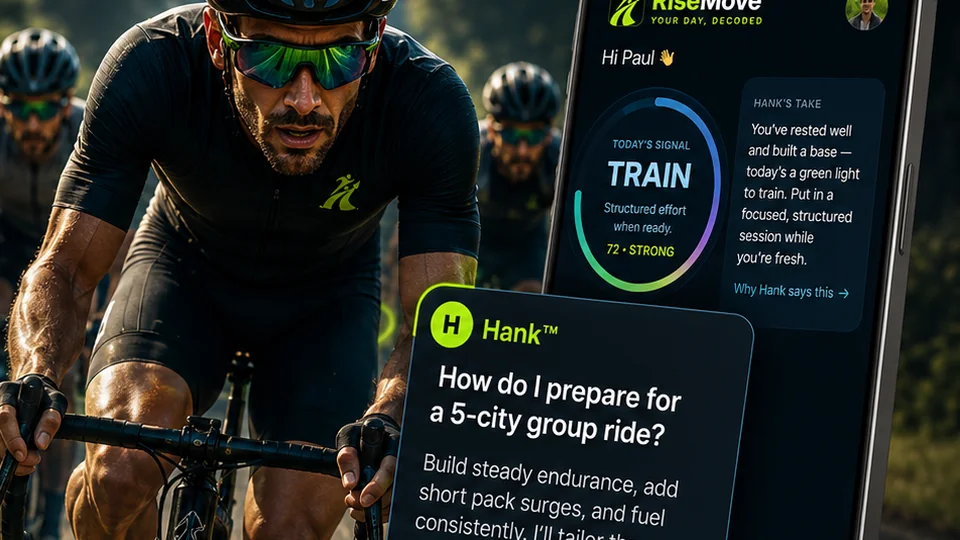
Train for the daily duration
Build long rides toward the time you expect to spend on the bike each day. You do not need to duplicate the full tour.
- Start with a duration you can recover from.
- Add time while the following days stay functional.
- Use occasional back-to-back rides for consecutive-day events.
Prepare for pack dynamics
Group rides are rarely steady. Practice brief controlled surges inside otherwise steady endurance rides.
The goal is not repeated all-out sprinting. It is learning to absorb changes in pace without turning the entire ride into a race.
A real Hank conversation
I have a group ride I’m interested in, a 5-city tour coming up. How do I train for it?
Hank™Train for that 5-city group ride by building steady endurance plus short “pack surge” efforts, and practice fueling.
Key workouts: a long steady ride that progresses toward the expected daily duration; 6–10 × 30–60 second hard surges with 2–3 minutes easy mid-ride; and a 30–45 minute very easy high-cadence recovery spin.
Fueling and hydration: 30–60 g carbohydrate per hour plus fluids regularly. Do not wait until you are hungry or thirsty.
Key workouts: a long steady ride that progresses toward the expected daily duration; 6–10 × 30–60 second hard surges with 2–3 minutes easy mid-ride; and a 30–45 minute very easy high-cadence recovery spin.
Fueling and hydration: 30–60 g carbohydrate per hour plus fluids regularly. Do not wait until you are hungry or thirsty.
Hank™ asked how many hours per day and how many days. Those details change the balance between duration, back-to-back rides, and recovery.
Practice the operational details
Use training to test fueling, bottle access, clothing, saddle comfort, first-hour pacing, and restraint when the group starts fast. Execution matters too.
Train the tour without forcing every day
RiseMove can help you decide whether today supports endurance, harder work, easy movement, or recovery. Hank™ can then help keep the tour preparation moving when the week changes.